


Find your roulette game
Explore the rules before choosing a table.
Each spin is a new event. Previous results do not make a number due.
How a Round of Roulette Works
- Get your chips. Roulette chips carry no printed value, so the dealer places a token on your stack to show what that colour is worth. Online, your balance works as your chips.
- Place your bets. Put chips on the numbers or sections of the layout you want to back, within the table limits.
- Follow the betting window. A dealer or game starts the wheel and ball. Only bets accepted before the “no more bets” call or on-screen deadline count. Do not assume a spinning wheel means betting is still open.
- The ball lands. It settles in one numbered pocket, and that number decides every bet on the table.
- The dolly goes down. The dealer places a marker, called the dolly or crown, on the winning number. While it is on the layout, nobody may place, collect or remove bets.
- Bets are settled. Losing bets are cleared and winning bets are paid at the fixed odds shown below. Once the marker comes off, betting opens for the next spin.
Online the sequence is the same, but you click to place chips; at live dealer tables a countdown replaces the dealer’s call. Curious about the job? Read our guide to becoming a roulette croupier.
Your first practice round
Start with one bet on one spin so the settlement is easy to follow. The free game’s optional practice lessons let you check the result afterwards.
- Wait for betting to open. Choose the $5 virtual chip and click Red once. Check that Your Bet shows $5; Undo or Clear removes an unwanted bet while betting is open.
- Stop when betting closes. Follow the round timer and wait for the result. You do not need to chase the previous spin or add another bet.
- Read the settlement. Red returns $10 in total: your $5 stake plus $5 profit. Black or 0 returns $0, a $5 loss. Zero is neither red nor black.
- Compare the balance before betting with the balance after settlement. If you started with $1,000 and made no other bets, it becomes $1,005 after red or $995 after black or zero.
Red wins on 18 of 37 pockets (48.65%), not half. A more frequent win does not mean a lower house edge. Learn how payouts and probabilities fit together.
Where to place three common bets
These simplified diagrams show chip placement on a physical layout. In a digital game, use its bet selector and check the highlighted numbers before confirming.
Red · 18 numbers
Place the chip inside Red. A winning 5-unit bet returns 10 units, including the stake; black or zero loses all 5.
Straight up · one number
Place the chip in the centre of 7. A winning 1-unit bet returns 36 units: 35 profit plus the stake. Any other result loses.
Split · two numbers
Place the chip on the shared border of 1 and 2. Either number wins. A 1-unit bet returns 18 units: 17 profit plus the stake.
These are individual bets, not a combined betting system. Practise placement without a timer in the betting table trainer; use its payout challenges to test what you have learned.
The Wheel and Table Layout
A roulette wheel has the numbers 1 to 36 plus green zero pockets. A European or French wheel has a single zero, 37 pockets in all. An American wheel adds a double zero (00), for 38 pockets.
The table layout arranges the numbers differently from their order around the wheel: the numbers 1 to 36 sit in a grid of three columns and twelve rows, with the zeros at the top and the outside bets around the edge.
A straight-up bet wins on one number; this corner wins on any of four. Payouts shown are profit, with the winning stake returned separately.
Inside Bets and Payouts
Inside bets are placed on specific numbers in the grid. They pay more because they are less likely to win.
| Bet | Numbers covered | Payout |
|---|---|---|
| Straight up | 1 number | 35 to 1 |
| Split | 2 adjacent numbers | 17 to 1 |
| Street | 3 numbers in a horizontal row | 11 to 1 |
| Corner | 4 numbers meeting at one corner | 8 to 1 |
| Six line | 6 numbers in two adjacent rows | 5 to 1 |
| First five (American only) | 0, 00, 1, 2, 3 | 6 to 1 |
Outside Bets and Payouts
Outside bets cover larger groups of numbers around the edge of the layout and win more often, at lower payouts.
| Bet | Numbers covered | Payout |
|---|---|---|
| Dozen | 1–12, 13–24 or 25–36 | 2 to 1 |
| Column | 12 numbers in one vertical column | 2 to 1 |
| Red or black | 18 numbers | 1 to 1 |
| Odd or even | 18 numbers | 1 to 1 |
| Low (1–18) or high (19–36) | 18 numbers | 1 to 1 |
Zero is not red, black, odd, even, low or high, so these bets do not win when it lands. For the chance of winning each bet, see our roulette odds and payouts guide. The payouts above match those published by Wizard of Odds, RouletteVision’s sister site, as well as New Jersey’s roulette regulations and the Venetian’s published rules.
European vs American vs French Roulette
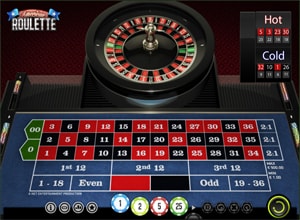
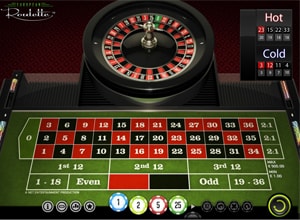
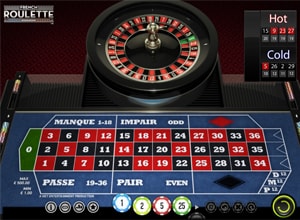
| Version | Zeros | Pockets | What happens on zero | House edge |
|---|---|---|---|---|
| European | 0 | 37 | Even-money bets lose, unless the table applies La Partage or En Prison | 2.70% |
| French | 0 | 37 | La Partage or En Prison on even-money bets, if offered: check the rules panel | 2.70%; 1.35% on even-money bets with La Partage. En Prison depends on its repeat-zero rule. |
| American | 0 and 00 | 38 | Even-money bets lose | 5.26% (7.89% on the first-five bet) |
If you have the choice, play French or European roulette: the extra 00 on the American wheel roughly doubles the house edge.
What Happens When the Ball Lands on Zero
A straight-up bet on zero pays 35 to 1 like any other number. Outside bets do not include zero, and even-money bets lose on zero unless the table applies one of two French rules:
- La Partage: you lose only half of your even-money stake; the other half is returned. The house edge on these bets falls to 1.35%.
- En Prison: your even-money stake is held for a later spin. A qualifying win releases the stake without profit; a loss forfeits it. Check what happens if zero repeats. Under the common rule that keeps the stake imprisoned on another zero, the edge is about 1.35%; variants that lose the imprisoned stake on zero differ.
Grouped together, the two rules lower the house edge on even-money bets to about 1.35% under the usual repeat-zero rule, compared with 2.70% without them. Check which rule, if any, a table uses before you sit down.
American Roulette Rules
American roulette uses the same bets and payouts as European roulette, plus the double zero pocket. The 00 lifts the house edge on every bet to 5.26%, apart from one extra bet.
That bet is the first five (sometimes called the top line): a single chip covering 0, 00, 1, 2 and 3, paying 6 to 1. It exists only on double-zero layouts, and its house edge is 7.89%, the worst on the table. It is the one bet to avoid. For more on this version, see our American roulette guide.
Racetrack (Call) Bets
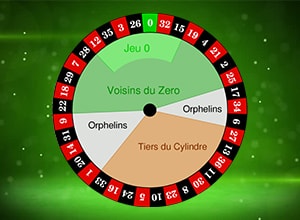 French and many European tables add a racetrack: an oval showing the numbers in wheel order, used to bet on sections of the wheel.
| Bet | Numbers covered | Section of the wheel |
|---|---|---|
| Voisins du zéro | 17 | The 17 numbers around zero, from 22 to 25 |
| Tiers du cylindre | 12 | The third of the wheel opposite zero, 27 to 33 |
| Orphelins | 8 | The two groups left over: 17, 34, 6 and 1, 20, 14, 31, 9 |
| Jeu zéro | 7 | 12, 35, 3, 26, 0, 32, 15 |
| Neighbours | Usually 5 with two neighbours selected; options vary | Any number plus the two on each side of it on the wheel |
For another bet that spreads across the layout, see the Red Snake Bet.
Table Limits and Etiquette Basics
- Each table displays a minimum and maximum bet, and you must stay within them.
- Don’t place, change or withdraw bets after the dealer calls “no more bets”.
- Wait for the dealer to clear the table and lift the marker before betting on the next spin.
- If you are using non-value colour chips, ask the dealer to exchange them before you leave the table.
For chip handling, timing and disputes at a physical table, see our roulette table etiquette guide.
Roulette is entertainment with a built-in house edge, not a way to earn money; read our responsible gambling advice before you play.
Roulette Rules FAQ
How many numbers are on a roulette wheel?
A European or French wheel has 37 pockets (1–36 and a single 0). An American wheel has 38 (1–36, 0 and 00).
What happens if the ball lands on zero?
Straight-up bets on zero win 35 to 1. Outside bets do not include zero, and even-money bets lose unless the table uses La Partage or En Prison.
What is the easiest roulette bet for beginners?
Even-money bets such as red or black are the simplest: they pay 1 to 1 and cover 18 numbers.
Which roulette version has the best rules for players?
French roulette with La Partage or En Prison, where the house edge on even-money bets is about 1.35% under the usual repeat-zero rule. European roulette is next at 2.70%, and American roulette is the least favourable at 5.26%.
What is the first-five bet in American roulette?
It is a bet on 0, 00, 1, 2 and 3 that pays 6 to 1. It carries a 7.89% house edge, higher than any other bet on the table.
Affiliate disclosure: we may earn commission from casino links. Commercial relationships can affect featured operators and exposure. How ratings and recommendations work. Offers may exclude roulette; check the terms.