
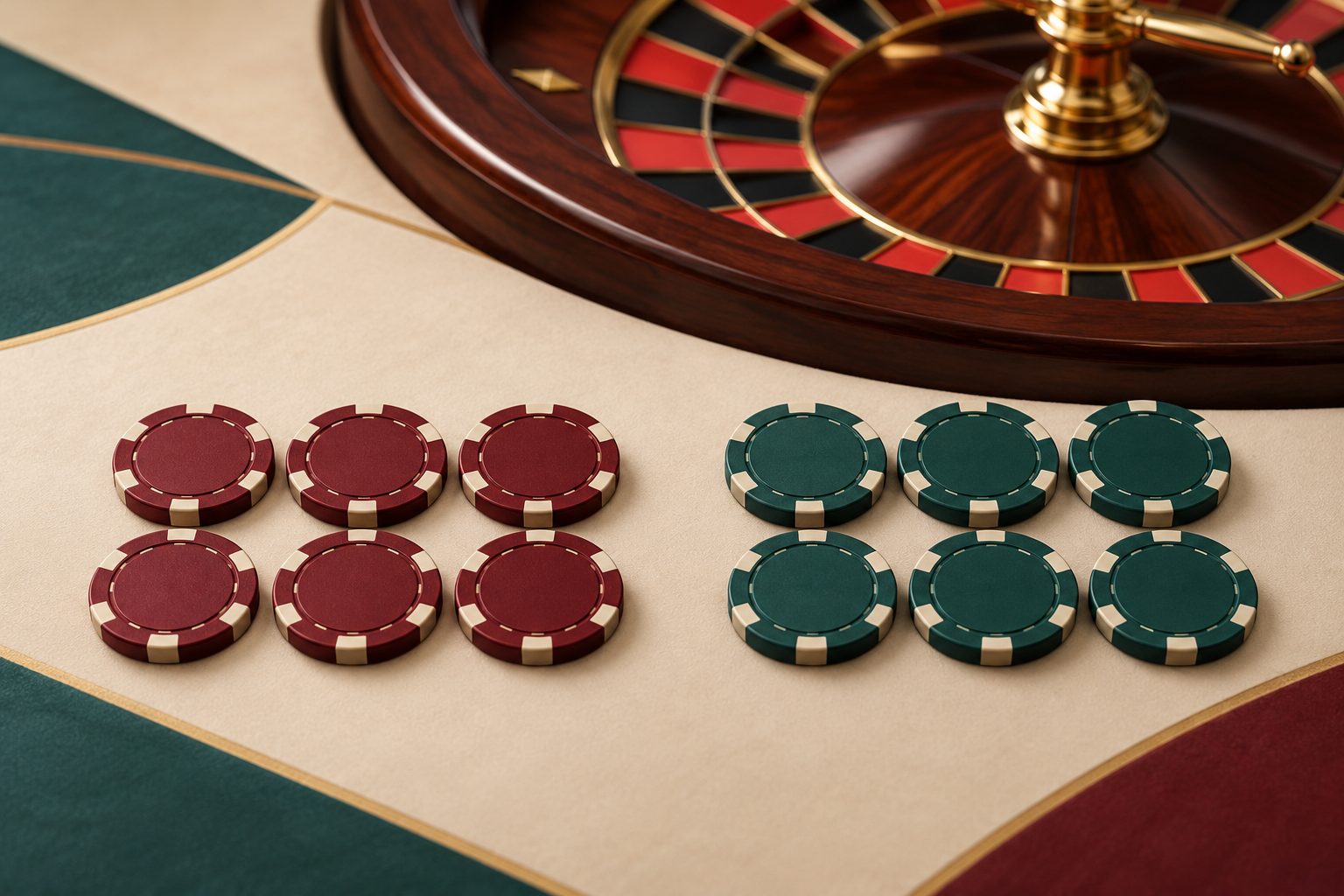
Double street, corner and straight-up bets
A double street, also called a six line, covers six numbers in two adjacent rows and pays 5:1 profit. A corner or quad covers a block of four numbers and pays 8:1. A straight-up bet covers one number and pays 35:1. In each case the winning stake is also returned. The Shotwell system combines a double street with straight-up bets in this way.
Double Street Quad / Five Quad at a glance
Two distinct six-unit examples: two 2-unit six lines plus a corner and a straight-up; or five 1-unit corners plus a straight-up. See the guide for exact numbers.
Illustrative example, not a prediction or recommended stake. Betting systems do not remove the house edge.The examples use one-unit chips on a standard 37-pocket European wheel. Zero is not covered. Table minimums and rules vary; the units are an illustration, not a suggested bankroll.
Example 1: Double Street/Quad, six units
| Bet | Numbers covered | Stake |
|---|---|---|
| Double street | 4–9 | 2 units |
| Double street | 16–21 | 2 units |
| Corner | 26, 27, 29, 30 | 1 unit |
| Straight up | 34 | 1 unit |
These groups do not overlap. Together they cover 17 pockets. A hit on either double street returns 12 units including that bet’s two-unit stake. After subtracting all six units wagered, the net profit is six units.
| Result | Pockets | Net per spin |
|---|---|---|
| Either double street wins | 12 | +6 units |
| The corner wins | 4 | +3 units |
| 34 wins | 1 | +30 units |
| An uncovered number or zero wins | 20 | −6 units |
The chance of a profitable spin is 17/37, or 45.95%. Expected net result is (12 × 6 + 4 × 3 + 1 × 30 − 20 × 6)/37 = −6/37 units, about −0.162 units per six-unit stake.
Example 2: Five Quad, six units
This version places one unit on each of five separate corners and one unit straight up on 33. “Five Quad” describes the five corner bets; the complete example still contains six bets.
| Bet | Numbers covered | Stake |
|---|---|---|
| Corner 1 | 1, 2, 4, 5 | 1 unit |
| Corner 2 | 8, 9, 11, 12 | 1 unit |
| Corner 3 | 13, 14, 16, 17 | 1 unit |
| Corner 4 | 20, 21, 23, 24 | 1 unit |
| Corner 5 | 25, 26, 28, 29 | 1 unit |
| Straight up | 33 | 1 unit |
The corners cover 20 different numbers, and 33 adds one more. A corner hit returns nine units including the winning chip. Subtract the full six-unit stake and the spin’s net profit is three units, not eight or nine.
| Result | Pockets | Net per spin |
|---|---|---|
| Any of the five corners wins | 20 | +3 units |
| 33 wins | 1 | +30 units |
| An uncovered number or zero wins | 16 | −6 units |
The chance of a profitable spin is 21/37, or 56.76%. Expected net result is (20 × 3 + 1 × 30 − 16 × 6)/37 = −6/37 units, exactly the same expectation as the first pattern.
More winning spins do not remove the house edge
Five Quad wins more frequently in these examples, but its common win is smaller. Both patterns lose an expected 0.162 units per six units staked on a fair European wheel. Dividing the expected loss by the amount wagered gives 1/37, or 2.70%.
A Five Quad result of two corner wins and one uncovered outcome has net results of +3, +3 and −6: three spins, 18 units wagered, and zero net profit. This short sequence is an arithmetic example, not a forecast of when a loss will arrive.
Adding double zero while retaining these payouts changes both examples to a 5.26% house edge. Overlapping corners also change the outcome distribution, so do not add their coverage counts as if every covered pocket were different.
Is a progression required?
No. The layouts specify where the chips go; a progression is a separate decision about how stakes change. Raising stakes after a loss increases the amount at risk and does not alter the underlying house edge. A budget or stopping point limits exposure, not the probability of the next result.
Compare the full roulette payout and probability chart, the betting rules and our explanation of Martingale’s losing-streak risk. Standard payouts were checked against the Wizard of Odds roulette rules; the tables above enumerate every pocket in the two stated examples.
Related systems: Canon betting system, Masse Égale betting and Andrucci system.
Updated 22 October 2026. Examples were recalculated using the stated rules. They illustrate probabilities and returns, not a record of casino testing or gambling results.
Affiliate disclosure: we may earn commission from casino links. Commercial relationships can affect featured operators and exposure. How ratings and recommendations work. Offers may exclude roulette; check the terms.
What is the bet progression on the 5 quad system?
Thanks for your help.